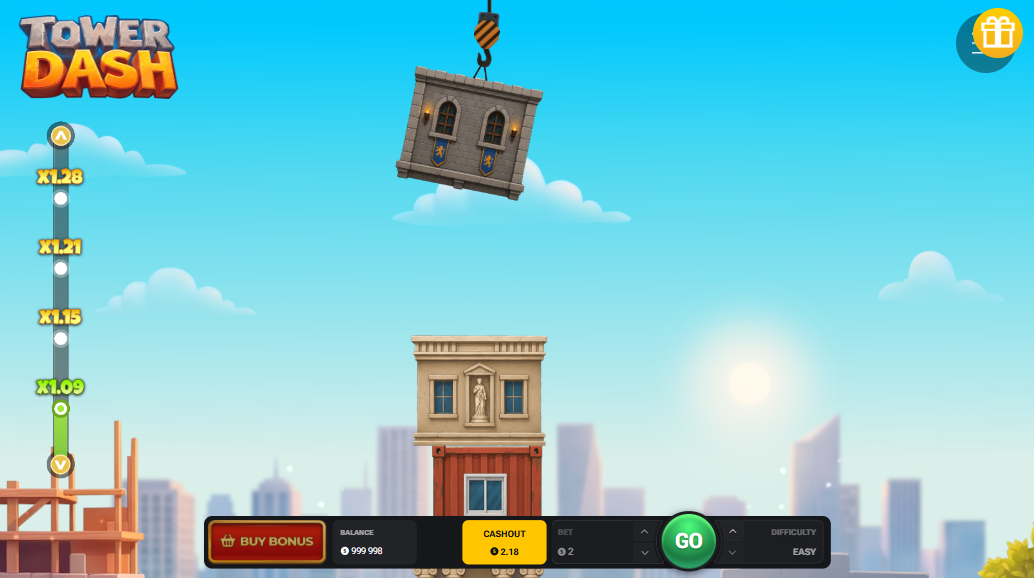
Over a bare plot of land, a crane swings its first load into position, and that is how Tower Dash opens: no walls, no floors, just one block rocking gently on a cable. Tower Dash then hands the next move to you.
A single tap lets the block drop. Land it squarely on the base and a multiplier lights up, while the crane is already fetching another piece.
The concept fits in a sentence. Every neat landing makes the stack taller and the potential payout bigger, yet every fresh block also carries the chance that the round ends badly. Between those two forces lies the single decision that counts: carry on, or bank the value the stack holds right now.
Rounds pass quickly, so sessions can gather speed. That briskness explains much of the charm. It is also a good argument for learning the rules first, before any real money goes in.
What follows covers the round itself, the two special blocks, cashing out, the published numbers, the approach to fairness, the devices it runs on and some sensible habits for keeping play enjoyable.
Tower Dash at a glance
Here are the essentials, gathered into one grid. Each value matches the published information. Some details are deliberately absent: launch date, accepted stakes and any difficulty settings are printed in the game rules attached to each casino's version, and those rules are worth opening before a first round.
| Item | Detail |
|---|---|
| Studio | InOut Games |
| Type | Instant game with brief rounds, where the player piles up a tower, one piece after another |
| Theme | Building site with cranes, piled-up blocks and a city skyline, in a bright, upbeat style |
| RTP | 96.05% |
| Volatility | Medium to high |
| Top win | 10,000 times the bet placed, which only the very highest stacks can unlock |
| Devices | Phone and desktop browsers; upright screen and one-touch control on mobile; no app needed |
Some of those lines need context. RTP is worked out over a vast amount of play, so it predicts nothing about an evening's results. A medium to high volatility rating tells you outcomes may lurch noticeably between rounds. As for the top win, think of it as a ceiling rather than something that turns up often.
InOut Games, the studio responsible, specialises in quick instant titles of this sort. Playing for money requires an adult aged 18 or above and a licensed online operator whose lobby includes the studio's games.
How a round works
First comes the stake. Once you confirm it, the crane delivers an opening block and play begins.
The tower then rises one unit at a time. Each block that comes to rest tidily on top of the previous one nudges the multiplier higher. That figure always applies to your original stake, so every good landing lifts what you could take home.
There are two possible endings. You can hit the cash-out button in a gap between blocks, and you receive the stake multiplied by the number then showing. Or the round can finish against you: a block slips past the edge and the stack topples, or the tower runs into a TNT crate. In both of those cases, play stops and the stake is gone.
Some quick arithmetic shows the principle. Suppose you put down A$3.30 and collect at x3; you would get A$9.90 back. Treat that as nothing more than a worked example. It does not tell you which block shows x3, how frequently towers climb that far or what a genuine round of Tower Dash will produce.
Each round stands alone. A tall stack moments ago gives no boost to the following attempt, and an early collapse offers no protection either. Previous outcomes carry zero information about later ones.
This independence explains why sessions can feel streaky. Several quick topples in a row are perfectly ordinary at this volatility level, as are long spells without a large multiplier.
Your stake remains fixed until the round finishes, which makes it the one setting fully in your hands. Picking a modest amount compared with your budget stretches a session further and cushions the ups and downs. Each casino's game rules list the accepted range.
Releasing a block
Each piece follows an identical little routine, and knowing it makes the opening rounds far less confusing.
- The crane glides in carrying a block and holds it above the highest point of the stack.
- Suspended there, the block rocks left and right, sweeping over the tower in a steady arc.
- One tap sets it free. This is the player's action and the only input required, although it plays no part in deciding the result.
- Down it comes. Settle cleanly and the multiplier rises, and collecting becomes possible before the following block. Overshoot the edge and the entire tower crumbles, finishing the round and taking the stake.
Step 3 deserves a frank word. In Tower Dash, your tap triggers the fall, while a random number generator, certified for the purpose, determines how each round turns out. Good timing, hours of practice or a careful finger do not alter that, and no tapping technique tilts the odds.
Seen in that light, the release works less like a reflex test and more like a natural pause. The meaningful choice happens in the gap after a landing, which the cash-out section explores.
TNT crates and Wild blocks in Tower Dash
Two unusual pieces may show up mid-round. One threatens the stack; the other can help it. The core rules stay the same, but both influence how a tower finishes or survives.
TNT crates
These crates are booby-trapped. Should the stack connect with one, play halts on the spot and the stake disappears, exactly as when a block falls wide.
Nobody has published how frequently a crate appears, and the game offers no pattern to decode. Consider them another way a round can stop abruptly, something that stings most when a tall tower is sitting on an attractive multiplier.
That is exactly where cashing out proves its worth. Money already collected sits beyond the reach of any crate. After you take a return, it is yours, and the next attempt starts over with a fresh stake.
Wild blocks
Wild blocks pull in the other direction. If a drop lands awkwardly, one of these can rescue it so the tower goes on climbing rather than toppling.
Spotting one is always pleasant, but it is no basis for planning. Their arrival, like every other element, comes from the random number generator, and no frequency figure exists. Enjoy one as a bonus; never build a decision around it.
Cashing out between blocks
You can only press cash-out in the window separating one block from the following one. Pressing it ends play on your terms, paying out your stake at whatever multiplier is on screen.
Practical thoughts on timing:
- Collection happens between blocks only, so you weigh it up while the crane is bringing the next piece, never while something is falling.
- What you receive is the stake multiplied by the value shown. Using the earlier example, A$3.30 taken at x3 returns A$9.90, but that is an illustration, not a forecast.
- Another block means a higher possible payout and a greater risk of leaving with nothing. Holding on is never free.
- Hunting enormous multipliers ranks among the fastest ways to drain a session. The maximum is real, yet it lives on the tallest stacks and is scarce by design.
- Settling on a personal collection point before a round begins keeps the moment calm. Choices made in a hurry, a split second before the release, are the ones most often regretted.
- A toppled tower does not have to be recovered. Bumping up bets to recover what is gone generally makes the hole deeper.
Within Tower Dash, none of these suggestions can overcome randomness. Their only job is to keep your pace and spending aligned with your budget.
The construction-site look
The graphics favour fun over suspense. Cranes line the edge of the site, colourful blocks pile up, and the outline of a city fills the background, giving every tower a clear sense of height.
That sunny palette keeps the atmosphere relaxed, even while a stack sways. Nothing feels gloomy or gritty. The scene reads more like a toy set than an actual worksite, a good fit for rapid, repeatable rounds.
The design is also practical. The arc of the crane is easy to track, the summit of the stack stays visible, and those distant buildings act as a handy yardstick for how high things have gone. On mobile, the upright layout mirrors the shape of a tower, letting it rise up the screen instead of getting cramped from the sides.
Visual appeal and probability are unrelated in Tower Dash. Vivid colours do not shift the odds, and an impressive stack silhouetted against the city is no nearer the top payout than the maths of each round permits.
RTP, volatility and top win
These three numbers describe long-term behaviour. Each is useful for framing expectations, provided you read it for what it really measures.
| Figure | What it means |
|---|---|
| RTP 96.05% | Across an extremely high count of rounds, the design pays back 96.05% of total stakes as winnings. It is a long-range average, not a promise for any session, and real sessions may end comfortably higher or noticeably lower. |
| Medium to high volatility | From one round to the next, outcomes can differ sharply. Stretches of small returns or quick collapses belong to normal play, while bigger payouts come along less frequently. |
| Top win of 10,000 times the stake | The largest payout possible. Only the highest stacks can get there, and the cap is firm: nothing larger is ever paid. |
With volatility in this band, the 96.05% average is made up of many ordinary results, occasional larger ones and a good number of losing rounds.
The RTP given here is the published value. The game rules of each version remain the place to confirm it, along with the stake range and any difficulty settings.
Treat the top win with caution. It is impressive precisely because it sits at the far edge of what the game can deliver. Shaping a session around chasing it is an easy way to overspend.
Random outcomes in Tower Dash
Outcomes come from a random number generator, or RNG, which has been certified. That certification confirms its output is truly random, with no concealed sequence anyone could take advantage of.
The practical meaning is straightforward. Your tap on each block is real and entirely yours, yet it has no say over the result. Repetition will make the controls feel second nature, but taller towers and fewer crates are not part of the bargain.
It also rules out forecasting. Since no round depends on the one before, a run of collapses never makes a big stack overdue, and a large payout never signals a short round next. History is silent about the future here.
Any product claiming to read outcomes in advance should therefore raise alarms. Predictor apps, bots, so-called signal groups and APK files offering secret access are fakes, and the game requires no download whatsoever. Websites peddling those tools, along with unlicensed casinos hosting copies of the game, are best left alone.
Free demo with virtual chips
Free play lets you see every mechanic at work without spending anything. Everything runs on virtual chips, and no real value is ever exposed.
Useful points about the demo:
- You can start without registering and without paying anything in.
- Virtual chips stand in for money, letting you follow the crane, the sway, the landings and both special blocks without exposure.
- Any winnings stay virtual and can never be cashed out.
- Rules and random outcomes behave exactly as in paid play, so the demo of Tower Dash offers a faithful picture of how rounds develop.
- Access varies by casino; some show the demo freely, others put it behind their own steps.
- It suits experimenting with a collection habit, such as banking at a modest multiplier, and noticing how often towers end early.
- It cannot teach anyone to beat the game. Because results are random, free rounds say nothing about upcoming paid ones.
- It is a chance to locate the cash-out control and stake settings ahead of time, lowering the risk of a rushed slip later.
For newcomers, a few demo rounds make a sensible start.
Phones, tablets and computers
Play happens inside a web browser, on mobile devices and desktop machines alike. With no app to install, getting started simply means loading the game at a licensed casino.
Phones get an upright layout that matches the way a tower grows. Control is reduced to one touch: tap the screen and the block drops. That keeps Tower Dash comfortable with one hand, even on a compact display.
Tablets add a little extra room, letting the stack and skyline breathe. On a computer, the game sits inside a browser window, and the release follows the same one-action principle.
Whatever the device, a steady internet connection matters, because losing signal midway through a session is irritating. On compact screens, confirm before you start that the cash-out control and stake settings are within easy reach.
Since nothing needs downloading, any so-called official app or APK for the game is a red flag, not a shortcut.
Real-money play
Real stakes bring a few plain conditions.
| Point | Detail |
|---|---|
| Where to play | Licensed online casinos offering games from InOut Games, nothing else |
| Age | 18 and over only |
| Choosing a casino | Confirm a valid licence, that the game is offered where you live, and that stake limits fit your budget |
| Getting started | Create an account at a licensed casino, complete its ID checks, add funds, and look for the game among the instant titles |
| Bonus terms | Every casino writes its own conditions: how much this title counts for wagering, possible exclusion of the game, and any bet ceiling during a bonus |
| Studio and casino | InOut Games makes the game; the licensed casino manages your account, payments and verification |
That split between studio and casino has real consequences. Anything about deposits, withdrawals or account checks belongs with the casino, because the studio keeps no player accounts.
Going through bonus conditions before accepting an offer prevents unpleasant surprises, particularly around game contribution and stake caps.
Playing Tower Dash responsibly
Quick rounds cut both ways. They are easy to enjoy, but they can also make minutes and money vanish faster than planned, since another tower always waits a single tap away.
Some simple routines help. Begin with small stakes to learn the rhythm without heavy swings. Fix a budget before you start, and view it as spending on leisure. Decide how long you will play, then stop once that time is up.
Breaks matter more than people expect. Walking away briefly after a string of collapses, or after a pleasing win, resets your thinking and steadies the next decision.
Licensed casinos usually supply tools to back these routines, including deposit caps and time limits, and many add self-exclusion. Switching them on reflects good planning rather than weakness.
If the game stops being fun, or money spent on it starts to weigh on you, turn to a professional help organisation for support. Conversations are confidential, and early contact tends to help most.
What to keep in mind
Seven plain facts belong in the back of your mind each time you play:
- Both a missed landing and a TNT crate finish the round, and either way the stake is lost.
- Volatility is rated medium to high, which makes wide swings and losing runs entirely normal.
- The maximum calls for the tallest towers, and nothing pays above 10,000 times the bet; that outcome is rare.
- Your tap releases each block, yet the certified generator alone decides the random result.
- Nothing, whether a method, a pattern or a tool, can guarantee winnings, and anything advertised that way deserves to be ignored.
- The 96.05% RTP refers to the long run, never to one session.
- Raising stakes or extending play to recoup losses usually enlarges them.
Bearing these in mind keeps the game in its proper place: a brisk, light-hearted stacking round with a genuine chance of losing each stake.